
Monday 7 June 2021 marks what would have been the 80th birthday of pianist, composer, educator and cultural industries advocate Hotep Idris Galeta (1941-2010) – a figure whose contributions to South African jazz at home and abroad have yet to be fully documented and understood.
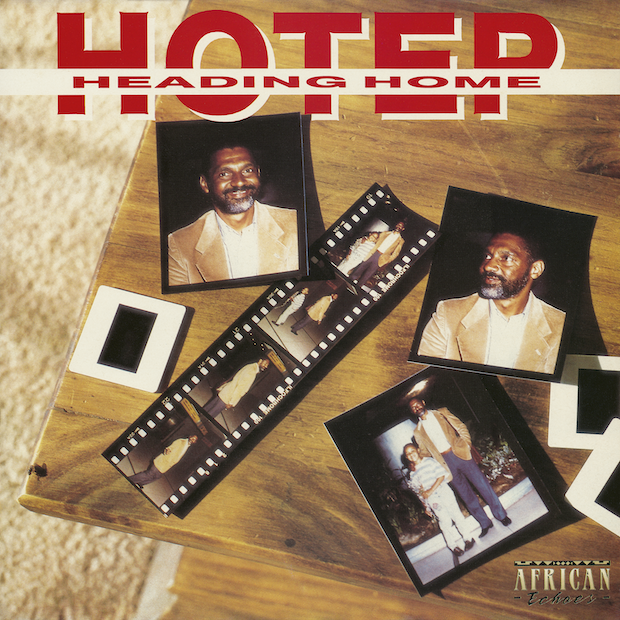
Galeta's 1990 magnum opus Heading Home was recorded in Cape Town during one of his first trips back to South Africa after living in exile for 30 years and he shines as a frontman and composer with the formidable backing of Khaya Mahlangu on sax, Spencer Mbadu on bass and Monty Weber on drums. Issued on the African Echoes imprint, Heading Home helped shape the profound themes and tone of South African jazz in the 1990s and, over thirty years later, Galeta's compositions still exude a timeless vitality.
A1. Heading Home 06:29
A2. Sister Fania 05:44
A3. NY 139 04:27
A4. Tiekkie Draai 03:16
B1. Happy Hanna 05:05
B2. District Six 04:42
B3. Cape Town Summer 05:54
Hotep Idris Galeta – Piano
Khaya Mahlangu – Tenor & Soprano Saxes
Spencer Mbadu – Bass Guitar
Monty Weber – Drums
All Compositions by Hotep Idris Galeta
(Except "Happy Hanna" composed by Hotep Idris Galeta and Caiphus Semenya)
Published by Ceilbar Music and Sun Music Publishers
(Except "Happy Hanna" published by Almo Irving Music and Mungale)
Executive Producer: Rashid Vally
Recorded at U.C.A. Studio in Cape Town by Murray Anderson
Mastered by Sam Wingate and Supervised by Eirfaal Gillan at Decibel Studio in JHB
Art Direction and Cover Design by Eirfaal Gillan
Photography: Mariam Gillan
Special thanks to Christian Syren for co-ordinating the recording sessions in Cape Town. Rashid Lombard for the photography of Spencer Mbadu and Monty Weber.
ORIGINAL LINER NOTES:
The tragedy of exile is a theme which has underpinned the lives of many South Africans, but for artists and musicians, the personal pain of separation, is further aggravated: uprooting from the community in which their art evolved necessitates a redefining, a redevelopment of the artform within the context of the new material reality which surrounds them.
So it has been for the generation of South African musicians who left South Africa in the early 1960's – they have charted their musical development in exile, nurturing severed roots for the appreciation of foreign audiences and fellow exiles. Back home, different forces have shaped the music.
After thirty years in exile, pianist Hotep Idris Galeta returned home to Cape Town in January 1990 to record and perform with a quartet of local musicians. This album celebrates the homecoming not only for Galeta, but for those in South Africa who have had that nagging awareness that the repatriation of a very big slice of our musical heritage is long overdue.
Born in the Cape Town suburb of Crawford in 1940, Galeta was raised on a musical diet ranging from bebop and marabi to vastrap and tikkiedraai. But by the age of 20, Galeta was hungry to gain a broader musical education: "I just felt that I was at an impasse because of the situation here. There was no inspiration." A year later, he moved to New York, where he spent time in an army band, studied theory, and soon started to play with people like High Masekela, Jonas Gwangwa and Morris Goldberg.
Since leaving Cape Town thirty years ago, Hotep Idris Galeta has recorded several albums with compatriot Masekela, as well as American musicians such as Herb Alpert. His own quest for musical education has motivated a career as teacher, and apart from regular tour and recording work, he currently teaches at Hartt School of Music, in Connecticut, USA, where he is professor of African and American Music.
Back in Cape Town, Galeta was joined in the studio by drummer Monty Weber, veteran of the numerous Abdullah Ibrahim recordings produced by Rashid Vally in the 1970's. Bassist Spencer Mbadu, with his substantial experience of contemporary mbaqanga and afro fusion, and saxophonist Khaya Mahlangu, a driving force in the afro-jazz group Sakhile, complete the quartet.
Until recently, Galeta had been unable to return to SA. Being in Cape Town, recording and performing with Monty Weber and the younger generation of "home" musicians after thirty years "outside" was exhilarating: "It was an incredible experience, one of the high moments of my life. It was a very spiritual and creative thing."
The interaction between the returned exile and the "homeboys" is more than symbolic in its unity: Galeta's compositions are finely structured, yet offer the flexibility to allow dynamic improvisation of melody and rhythm. Working through material ranging from the jazz mainstream to marabi, mbaqanga and bossanova, Galeta and his quartet bear testimony to the enormous potential which lies in interaction between two schools of musicians who have been separated by Apartheid.
Most important, we come to realise that the absence of a generation of exile musicians has stunted the growth of South Africa's music culture, impoverishing musicians and listeners alike. Hotep Idris Galeta's return marks the beginning of a process which will surely see our music blossom, healing and uniting our land as we move towards cultural and national unity.
– Steve Gordon
Cape Town, February 1990
Cat. No. AE 7862
℗ 1990 © 2021 As-Shams Archive

Hotep Galeta with friend and producer Rashid Vally (June 1990)
