Showing posts with label 1975. Show all posts

MIKE MAKHALEMELE - Greatest Hits 1975-1982

A chronological journey through the early years of South African saxophonist Mike Makhalemele (1938-2000) and a showcase for his five classic albums from the As-Shams Archive catalogue.

Adapting the playlist and artwork of a 1978 compilation issued on the Flame label, Greatest Hits 1975-1982 features remastered tracks from the albums The Peacemaker (1975), The Bull and The Lion (1976), Peaceful Eyes (1976), Walking Spirit (1977) and Blue Mike (1982).

1. Going West 05:02
2. Snowfall 05:25
3. Peaceful Eyes 05:03
4. Walking Spirit (Dancing Soul) 07:36
5. I Remember You (Dedicated to Henry Sithole) 07:46

DIGITAL ALBUM

All Tracks Composed by Mike Makhalemele

Track 1 from the album The Peacemaker (1975):
Tenor Sax – Mike Makhalemele
Recorded by Allan Glen at Satbel Studios
Produced by Mike Makhalemele

Track 2 from the album The Bull and The Lion (1976):
Sax, Voices – Mike Makhalemele, Winston Mankunku Nkozi
Guitar – Trevor Rabin
Piano – Tete Mbambisa
Bass – Ronnie Robot
Drums – Neil Cloud
Recorded by Paul Dobbe at Satbel Studios
Produced by Jo'Burg Records

Track 3 from the album Peaceful Eyes (1976):
Tenor Sax – Mike Makhalemele
Recorded by Tony Butler at Satbel Studios
Produced by Jo'Burg Records

Track 4 from the album Walking Spirit (1977):
Tenor Sax – Mike Makhalemele, Stanley Sithole
Trumpet – Danny Sithole
Keyboards – Jabu Nkosi
Guitar – Paul Petersen
Bass – Tonny Saoli
Drums – Nelson Magwaza
Recorded by Greg Cutler at Satbel Studios
Produced by Julian Laxton

Track 5 from the album Blue Mike (1982):
Tenor Sax – Mike Makhalemele
Piano, Organ – Jabu Nkosi
Bass – Zulu Bidi
Drums, Percussion – Nelson Magwaza
Produced by Rashid Vally

Remastered by Richard Vossgatter 
Compiled and Produced by Calum MacNaughton

Cat. No. KRS 204
℗ 1975, 1976, 1977, 1982 © 2026 As-Shams Archive

KIPPIE MOKETSI - Hard Top

As-Shams Archive Vol. 5: Kippie Moketsi - Hard Top


Hard Top assembles the previously unreleased 1975 recordings of revered South African saxophonist Kippie Moeketsi (credited most commonly during the 1970s using the spelling variation Moketsi). The 2LP vinyl edition is presented in a gatefold sleeve featuring archival artwork by Mafa Ngwenya and comes from As-Shams/The Sun on the heels of Tete Mbambisa's African Day album in 2024.

By 1975, at the age of 50, saxophonist Kippie Moeketsi had already earned his stripes as a South African jazz figurehead. His tenure with the Jazz Epistles and the cast of the "South African Jazz Opera" King Kong in the late-1950s had not only marked his own rise in prominence but also seen him help catalyse the momentum of a younger generation of iconic artists who would go on to become the defining figures of modern South African jazz. While he didn't enjoy the same international attention as his protégés Miriam Makeba, Hugh Masekela and Abdullah Ibrahim, his noble and dedicated career on the local jazz scene until his death in 1983 saw him forge an enduring legacy.

Owing to the efforts of record producer Rashid Vally, Kippie Moeketsi's journey through the 1970s is beautifully documented, most notably on the albums Dollar Brand + 3 (1973), Tshona! (1975) and Blue Stompin' (1977), in which he shares the spotlight with Abdullah Ibrahim, Pat Matshikiza and Hal Singer respectively. As a featured performer on Soul of the City's Diagonal Street (1975) and Dennis Mpale's Our Boys are Doing It (1977), Moeketsi is seen embracing the popular orientations of South African jazz in 1970s but, having come up in the 1940s and 1950s, he never forgot his roots as an admirer and dedicated scholar of Classic American Jazz.

While Moeketsi did write some memorable compositions, it was in the role of interpreter that he shone most brightly. With its title derived from a good-natured nickname that nodded to Moeketsi's elder status by way of his receding hairline, Hard Top is a covers album that looks back in time to the era of rhythm and blues while also indulging 1970s pop and funk with a decidedly South African vibe.

Marking the 100th anniversary of Kippie Moeketsi's brith on 27 July 1925 and officially joining his catalogue 50 years after it was recorded, Hard Top celebrates the multiple dimensions of a veritable South African jazz legend. The release also provides an opportunity to reflect on the unwavering support of his producer, fan and friend Rashid Vally, who passed away in December 2024.

A1. It Was a Very Good Year (E. Drake) 06.50
A2. Swallowin' the Blues (K. Graham) 13.19

B1. New Cambridge Blues (H. Baker, C. Hodges) 11.45
B2. Untitled (By Dennis Mpale) (D. Mpale) 06.08

C. I Can See Clearly Now (J. Nash) 17.18

D1. Black Frost (B. James, G. Washington) 06.44
D2. Wavy Gravy (K. Burrell) 11.22

Alto Sax – KIPPIE MOKETSI *
Tenor Sax – DUKE MAKASI
Bass – SIPHO GUMEDE
Drums – GILBERT MATTHEWS

A1, A2, A3 – Undated / Engineer: Robin Ritchie
Piano – PAT MATSHIKIZA

A4 – Dated 18 August 1975
C, D1, D2 – Dated 2 October 1975
Alto Sax – BARNEY RACHABANE
Piano – JABU NKOSI
Guitar – ENOCH MTHALENI
Trumpet – DENNIS MPALE

Recorded in 1975 at Gallo Sound Studios,
Johannesburg, South Africa
Produced by RASHID VALLY

Cover Artwork by MAFA NGWENYA

ON VINYL EDITION
Gatefold Artwork by MAFA NGWENYA
Back Cover Photo by EVANS MAKAPANA MBOWENI

Tape Transfers by Rob Allingham
Audio Mastering by Noah Mintz
Design and Layout by Rouleaux van der Merwe
Compiled and Produced by Calum MacNaughton
Executive Producer: Rashid Vally

* NOTE ON SPELLING
Moeketsi is the standard version of the South African family name and the spelling most commonly used when referring to Kippie. Physical and digital editions of Hard Top apply the spelling variant Moketsi, which was used for Kippie's artist credits throughout the 1970s, appearing on the albums Dollar Brand + 3 (1973), Tshona! (1975), Sikiza Matshikiza (1976), Blue Stompin' (1977) and Our Boys are Doing It (1977). It is not known why this variant was adopted but it remains in use for his As-Shams Archive discography while general commentary about Kippie defers to the standard spelling.

Cat. No. ASA105
℗ 1975 © 2025 As-Shams Archive

BLACK DISCO - Black Disco & Black Disco 3

With a Yamaha organ and a dream, Pops Mohamed started his musical journey in mid-1970s South Africa as the founder of Black Disco, creating a hip and innovative blend of chill-out jazz with spiritual overtones. Playing original compositions as well as reimagined soul and pop hits, the group appeared on producer Rashid Vally's As-Shams/The Sun label alongside Abdullah Ibrahim and Harari.

On the band's self-titled debut from 1975, Mohamed's cosmic organ is supported by two of the most sought-after session players on the South African jazz scene, Cape Town's sax and flute wizard Basil Coetzee, who had risen to fame in 1974 as one of the soloists on the hit “Mannenberg,” and Sipho Gumede, the young bass prodigy from the city of Durban. The album is a mostly downtempo affair with the drum machine on Mohamed’s organ laying down the beat while the trio soars in blissful improvisational territory.

Bassist Peter Odendaal and drummer Monty Weber join Mohamed and Coetzee for Black Disco 3 in 1976, preserving the New Age lounge aesthetic but allowing the group to flex their jazz chops more adventurously. “Spiritual Feeling” from the debut album is revamped as “Spiritual Feeling Riding the Blue” but the album opener “Dawn” is the centrepiece – a trippy, flute-driven awakening that unfolds over a period of ten minutes.

BLACK DISCO (1975)
Organ - Pops Mohamed
Flute / Tenor Sax - Basil Coetzee
Bass - Sipho Gumede

BLACK DISCO 3 (1976)
Organ / Guitar - Pops Mohamed
Flute / Tenor Sax - Basil Coetzee
Bass - Peter Odendaal
Drums / Bongos - Monty Weber

The MANKUNKU-MAKHALEMELE Trilogy

Three As-Shams Archive albums from the mid-70s that trace the interweaving discographies of saxophonists Winston Mankunku Ngozi and Mike Makhalemele. Backed by The Cliffs, Alex Express was Mankunku's long-awaited 1975 sophomore album that followed the lauded Yakhal' Inkomo with the Mankunku Quartet from 1969. Also appearing in 1975, The Peacemaker was Makhalemele's debut – a landmark release announcing the arrival of a new saxophone colossus. The Bull and the Lion from 1976 saw these two figureheads joining forces for one of the epic collaborations of South African jazz in the 1970s. Restored, remastered and reissued in partnership with We Are Busy Bodies.

MIKE MAKHALEMELE - The Peacemaker

Hailing from Alexandra and nicknamed "Ratau" (meaning "lion"), saxophonist Mike Makhalemele (1938-2000) was a force of nature with a robust yet soulful tone and seemingly endless breath. He embraced the pop music scene as an enthusiastic collaborator and staked his territory at the intersection of township grooves with modern currents in soul, funk and disco. As a solo artist, he delivered a formidable run of albums in the 1970s that that made him the most prolific recording artist in South African jazz during this era.

First issued in 1975 by the maverick independent label Jo’Burg Records, his debut The Peacemaker was a tour de force that introduced Makhalemele’s heavyweight sax prowess (deftly accompanied by Jabu Nkosi on keys and Sipho Gumede on bass) while showcasing his innovative approach as a composer and arranger. To mark the arrival of a new saxophone colossus, the album’s profile portrait cover boldly evoked the iconic Yakhal’ Inkomo by the Mankunku Quartet from 1969. Mike Makhalemele and Winston Mankunku Ngozi would go on to share the spotlight on a collaborative release entitled The Bull and the Lion in 1976.

Arranged by Mike Makhalemele
Recorded at Satbel Music Recording Studios
Recording Engineer: Allen Glen
Photography by Georgina Karvelas

Originally issued in South Africa by Jo'Burg Records
Cat. No. TJL 13005
℗ 1975 © 2023 As-Shams Archive

THE CLIFFS feat. WINSTON MANKUNKU NGOZI - Alex Express


Hailing from Cape Town, tenor saxophonist Winston Mankunku Ngozi (1943-2009) is a venerated figure in the pantheon of South African jazz. Inspired by Coltrane while rooted in indigenous folklore, he released the classic album Yakhal’ Inkomo at the outset of his career with the Mankunku Quartet in 1969. Backed by the Cliffs, Alex Express documents Mankunku’s return to the studio in 1975 with a handful of new and original compositions and his inimitable tone on full display. Shaking off the burden of Yakhal’ Inkomo, which was heralded as an earnest manifesto for modern South African jazz, the album is a carefree affair that leans into township grooves with joyful exuberance. In addition to a collaborative project with Mike Makhalemele entitled The Bull and the Lion, Alex Express is the first of just two rare snapshots of Mankunku in the 1970s. Disillusioned by the recording industry, it would take until his resurgence in the 1990s for Mankunku to flesh out his recorded legacy.

Speculated Personnel (Originally Uncredited):

ALTO SAX – Winston Mankunku Ngozi
TRUMPET – Stompie Manana
TRUMPET – George Tyefumani
ORGAN – Roger Khoza
GUITAR – Allen Kwela
BASS – Philip Kiti
DRUMS – Peter Jackson

All Tracks Composed by W. Ngozi

Originally issued in South Africa by The Record and Tape Company
℗ 1975 © 2023 As-Shams Archive

ALLEN KWELA - Black Beauty

Born in 1939 with his roots in rural Kawzulu-Natal, Allen Kwela began his career as a collaborator of Spokes Mashiyane, playing the iconic pennywhistle-based kwela style that was his namesake. He evolved into a South African jazz bandleader and composer in the 1970s, releasing Allen's Soul Bag at the helm of the Allen Kwela Octet in 1972. Issued on the maverick Soweto label, Black Beauty followed in 1975 with a set that blends township grooves with jazz-rock influences and features Kippie Moeketsi on saxophone. Kwela enjoyed an enduring career as a teacher, session player and solo artist through the 1990s until his death from an asthma attack in 2003. In the esteemed company of the likes of Themba Mokoena, Enoch Mthalane and Sandile Shange, he is remembered as one of the legendary South African jazz guitarists of his generation.

Allen Kwela – Guitar
Kippie Moeketsi – Alto Saxophone

A Jo'Burg Records Production
Sleeve Design by Space & Design
Photography by Baroness de Rosner

Originally issued on the Soweto label
Cat. No. SWA 14013
℗ 1975 © 2023 As-Shams Archive

BRA SELLO - Butterfly & The Battle of Disco


With one foot planted in jazz and the other in the township groove of mbaqanga, saxophonist Sello Mmutung was a powerful crossover figure in the history of popular music in South Africa. Using the stage name Bra Sello, meaning “brother” and used as a term of affection and respect in the jazz community, he came up in the era of shellac 78s as an exponent of the 1960s sax jive sound that brought the swinging rhythm of kwela into the domain of South African jazz. Despite the injection of American rhythm and blues into South African pop in the late-1960s, Bra Sello’s first releases on vinyl on the CBS label saw him backed by the group Abafana Bentuthuko and holding down an unapologetic township sound.

Joining the independent Soweto label under producer Cambridge Matiwane in the mid-1970s, Bra Sello recorded two platters in the hit-making bump jive style popularised by serious jazz musician Dollar Brand on the one hand and prolific studio group the Movers, operating in funk and soul territory, on the other. Blending modern American and traditional African elements into joyful hip-swinging rhythms, Butterfly (1975) and The Battle of Disco (1977) reflect the vivacity of urban life in South Africa and document an era when dance music was performed by bands as extended jams laced with jaw-dropping solos. With music trends shifting dramatically in the late-1970s, the title of The Battle of Disco was an ironic call to arms in response to the territory that group musicians were beginning to cede to synthesisers and DJs.


Originally issued on the Soweto label
Butterfly (1975) Cat. No. SWA 14014
Composed by S. Mmutung, C.B. Matiwane / Produced by C.B. Matiwane
The Battle of Disco (1977) Cat. No. SWA 14018
Composed by S. Mmutung / Produced by Sello Mmutung
℗ 1975, 1977 © 2023 As-Shams Archive

The MOKETSI-MATSHIKIZA Trilogy


Three As-Shams albums from the mid-1970s that trace the interweaving discographies of saxophonist Kippie Moeketsi and pianist Pat Matshikiza. Tshona! was their collaborative effort from 1975, supported by Basil Coetzee on tenor and with Beaters/Harari holding down the rhythm section. Matshikiza would then invite Moeketsi to feature on his solo debut Sikiza Matshikiza in 1976, this time backed by Spirits Rejoice. Matshikiza later pops up on the Harold Baker/Charles Hodges composition "Hang On There" covered on Moeketsi's Blue Stompin' album in 1977. Restored, remastered and reissued in partnership with We Are Busy Bodies.

PAT MATSHIKIZA & KIPPIE MOKETSI - Tshona!

As a member of the all-star Jazz Epistles in the late 1950s, saxophonist Kippie Moeketsi (also spelled Moketsi during his tenure with the As-Shams record label in the 1970s) was one of the key pioneering forces of modern South African jazz. While Jazz Epistles bandmates Hugh Masekela and Abdullah Ibrahim would go on to build their careers in the United States in the 1970s, it was at home in South Africa that Moeketsi would leave his mark on the domestic jazz scene. From the outset of record store owner Rashid Vally's forays into the production of independent jazz in the early 1970s, Moeketsi played a key role, notably as a featured sideman on Abdullah Ibrahim's Dollar Brand Plus 3 in 1973.

While Moeketsi had a reputation as a great interpreter of standards with a firm grasp of jazz as an American idiom, he stepped into deep South African jazz territory with a pair of his own compositions on the album Tshona! (released on Vally's nascent As-Shams/The Sun label in 1975). With equal participation from pianist Pat Matshikiza (also a well established South African jazz figure at the time), Tshona! emerges as one of the great South African jazz collaborations of the 1970s and is revered as a canonical recording from this era. Moeketsi and Matshikiza were flanked by the Soweto's hottest rhythm section by way of drummer Sipho Mabuse and bassist Alec Khaoli of Harari and featured on tenor sax was none other than Basil Coetzee, who's contribution to Abdullah Ibrahim's breakout hit record Mannenbeg - 'Is Where It's Happening' the year prior had earned him the esteemed appellation Basil "Mannenberg" Coetzee.

With the album cover bearing a playful illustration of a pair of township thugs by artist Mafa Ngwenya, Tshona! is the ultimate jazz document of its time and place - modern, urban, original, authentic and unmistakably South Africa. Moeketsi and Matshikiza would continue to record together for As-Shams/The Sun with Moeketsi featured on Pat Mathsikiza's Sikiza Matshikiza album in 1976. Matshikiza returned the favour in 1977, appearing on Moeketsi's Blue Stompin' album, which featured the Hal Singer Quartet on the title track.

A1. Tshona (P. Matshikiza) 11:40
A2. Stop and Start (P. Matshikiza) 05:09

B1. Umgababa (K. Moketsi) 11:11
B2. Kippie's Prayer (K. Moketsi) 03:35

Pat Matshikiza –Piano
Kippie Moketsi – Alto Saxophone
Basil Coetzee – Tenor Saxophone
Alec Khaoli – Bass
Sipho Mabuse – Drums
Dennis Phillips – Alto Saxophone on "Tshona"

Recorded at Gallo Studios
Recording Engineer: Peter Ceronio
Produced by Rashid Vally

Cat. No. GL 1796
℗ 1975 As-Shams/The Sun © 2022 As-Shams Archive

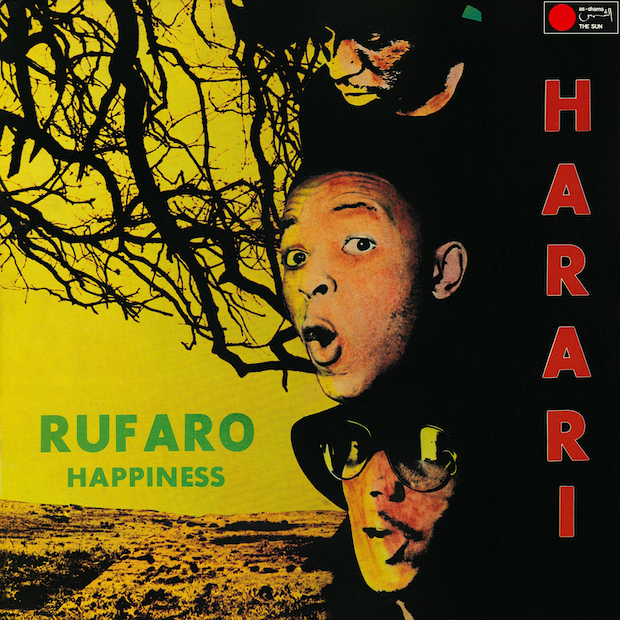
HARARI - Beaters & Rufaro


Keyboards • Vocals - Selby Ntuli
Bass - Alec Khaoli
Drums - Sipho Mabuse
 
Recorded at Gallo Studios
Engineer: Peter Cerenio
Produced by Rashid Vally
Original Release 1975 • Cat. No. GL 1814
 

Keyboards • Vocals - Selby Ntuli
Bass - Alec Khaoli
Drums - Sipho Mabuse
 
Recorded at Gallo Studios
Engineer: Peter Cerenio
Produced by Rashid Vally
Original Release 1976 • Cat. No. GL 1874
 
FEBRUARY 2021: Friends and bandmates from schooldays, Selby Ntuli, Sipho Mabuse and Alec Khaoli already had a pair of sturdy rhythm and blues records on CBS under their belt by the mid-70s but it was over the course of two formidable albums with As-Shams in 1975 and 1976 that they transitioned into the Afro-rock juggernaut that would forge South Africa's most unique and successful modern dance sound of the era. It was also over the course of these two albums that the Beaters would transition into Harari, taking on the identity of their signature song, which in turn took its name from what would later become the capital city of Zimbabwe. Mastered from original tapes with beautifully restored artwork and comprehensive notes, Beaters - Harari (1975) and Harari - Rufaro (1976) are due for reissue by Matsuli Music on 1 March 2021.